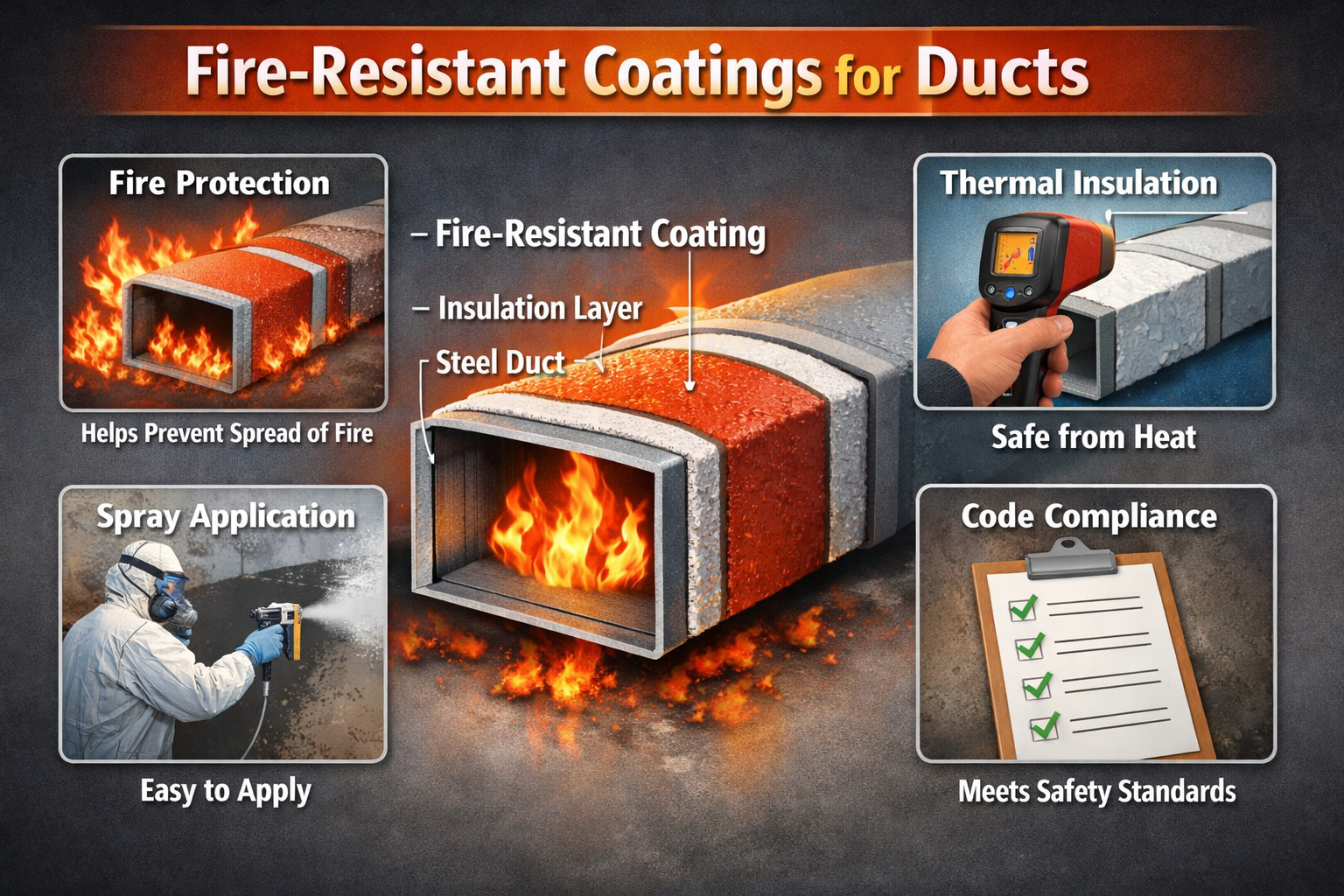
Fire safety is one of the most essential design priorities in modern buildings—whether residential, commercial, industrial, or institutional. Among the many components that require fire protection, HVAC duct systems often remain overlooked. Yet, during a fire, ducts can become dangerous pathways that enable flames and smoke to travel rapidly from one zone to another.
This is where fire resistant coating for ducts becomes a critical safety solution. Designed to insulate, protect, and restrict heat transfer, these coatings offer a powerful line of defense against fire spread—significantly improving building safety.
This blog explores everything you need to know about fire-resistant duct coatings, including how they work, benefits, application techniques, and compliance considerations.
What Are Fire-Resistant Duct Coatings?
Fire-resistant duct coatings are specialized intumescent or ablative protective layers applied to HVAC ducts to enhance fire protection. When exposed to extreme heat, these coatings either expand, insulate, or chemically convert into a barrier that prevents rapid heat transfer and structural failure.
Instead of allowing fire to spread through metal ductwork, the coating keeps the internal temperature significantly lower—protecting both property and occupants.
These coatings are widely used in:
- Commercial buildings
- Industrial plants
- Hospitals
- Shopping malls
- Server rooms
- Hotels
- Educational institutions
-
Underground facilities
They are essential in any space where air movement systems are present.
Why Is Fire Coating Necessary for HVAC Ducts?
Ductwork plays a major role in circulating air throughout a building. But during a fire, this same network can spread:
- Heat
- Smoke
- Toxic gases
- Flames
Steel ducts can quickly rise to temperatures above 1000°C, losing structural integrity. Without fire protection, sections can collapse, leak, deform, or melt—resulting in dangerous openings that cause fire to move between compartments.
Fire-resistant coatings offer:
- Life safety protection
- Structural stability
- Reduced flame and smoke spread
- System integrity during emergencies
How Do Fire-Rated Coatings Work?
Most fire-resistant duct coatings rely on one of the following mechanisms:
Intumescent Reaction
At high temperatures, the coating expands many times its original thickness, forming a thick char layer.
This layer prevents:
- heat transfer
- surface ignition
- structural collapse
Ablative Insulation
Ablative coatings absorb heat by gradually breaking apart or evaporating, preventing duct temperatures from increasing rapidly.
Chemical Conversion
Some coatings form heat-resistant ceramic or carbonized layers that block fire penetration.
Key Benefits of Fire-Resistant Coatings for Ducts
Fire & Smoke Containment
Coating helps maintain compartmentalization, preventing smoke and fire from traveling to other areas.
Temperature Resistance
Many coatings withstand temperatures up to 1200°C—maintaining structural integrity of ductwork.
Protection Without Structural Reinforcement
Instead of wrapping or replacing ducts, coatings provide a simpler and cost-effective solution.
Enhances Building Safety Standards
Helps buildings meet fire safety regulations such as:
- BS 476
- NFPA standards
- UL 1709
- EN fire codes
Improves Response Time During Emergencies
If fire spreads more slowly, evacuation time increases—improving survival rates.
Resistance to Corrosion & Moisture
Some coatings also offer additional protection against chemical or atmospheric damage.
Long-Lasting & Low Maintenance
Once applied, coatings function for years with minimal touch-up requirements.
Types of Fire-Resistant Duct Coatings
Solvent-Based Coatings
Strong and durable, suitable for both indoor and outdoor ductwork.
Water-Based Coatings
Environmentally friendly, odor-free, and fast drying—popular for hospitals and offices.
Intumescent Coatings
Preferred in high-risk or high-temperature environments.
Ablative Coatings
Ideal for ducts exposed to chemical heat or mechanical stress.
Where Fire-Resistant Coatings Are Used on Ducts
They provide protection across all major duct areas, including:
- Kitchen exhaust ducts
- Commercial HVAC ducts
- Pressurization ducts
- Smoke extraction ducts
- Stairwell ducts
- Underground ducting
Especially in industrial buildings, kitchen workplaces, or high-risk areas, coatings are indispensable.
Fire Rating & Compliance Requirements
Duct fire coatings are typically tested for:
- 60 minutes
- 90 minutes
- 120 minutes
- 180 minutes
- 240 minutes
The required rating depends on:
- building size
- occupancy type
- fire zone classification
- duct system design
Regulatory bodies expect coating performance that protects structural stability and prevents duct leakage.
Installation & Application Process
Here is how professionals apply duct coatings:
Step 1: Surface Preparation
Ducts are cleaned to remove:
-
oil
-
dust
-
moisture
-
loose particles
Step 2: Primer Layer
A bonding primer is applied to ensure adhesion.
Step 3: Coating Application
Using brush, roller, or spray, the coating is applied in:
- uniform thickness
- multiple layers
- controlled coverage
Step 4: Thickness Verification
Dry film thickness (DFT) is measured to ensure compliance.
Step 5: Inspection & Testing
Final approval checks include surface integrity and safety verification.
Professional installation ensures performance reliability during emergencies.
Maintenance & Durability
Once installed, fire-resistant coatings deliver long-term protection.
However, periodic inspections are necessary to check:
- cracks
- discoloration
- peeling
- moisture penetration
- mechanical damage
Touch-ups restore full fire protection value when needed.
Cost Factors
Pricing depends on:
- duct size
- coating type
- fire rating duration
- thickness requirements
- labor charges
- geographic location
Although coatings have an upfront cost, they are more affordable than fire-rated duct fabrication or full system replacement.
Conlusion
Fire-resistant coatings for ducts are an essential safety investment—protecting buildings, equipment, and human lives. They prevent heat transfer, reduce smoke movement, and maintain duct integrity during fire emergencies. With strong compliance ratings, durability, and cost-effectiveness, these coatings are a vital part of modern fire protection strategies.
As fire safety regulations continue to advance, the demand for reliable duct protection solutions will only increase. Investing in fire-resistant duct coatings today will ensure long-term security, peace of mind, and compliance for years to come.